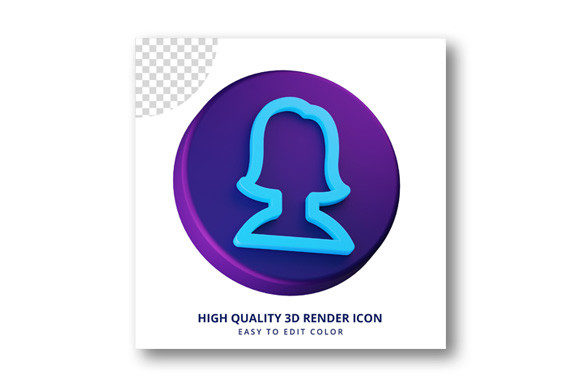
Enhancing Digital Interfaces with a Female Avatar Icon in 3d Rendering
In the rapidly evolving landscape of digital design, first impressions are everything. Whether you are crafting a sleek landing page, designing a mobile application, or creating a social media campaign, the visual elements you choose play a pivotal role in user engagement and brand identity. One specific asset that has gained significant traction among designers and developers is the Female Avatar Icon in 3d Rendering. This isn't just a simple graphic; it is a versatile tool that bridges the gap between technical precision and human connection.
When integrated into a 3D icon for UI kits, these avatars offer a level of depth and realism that flat icons often struggle to achieve. They serve as more than mere decoration; they act as digital representatives, guiding users through complex interfaces with a sense of familiarity and trust. Let’s explore how this specific type of asset can transform your projects, from web banners to comprehensive marketing strategies.
The Power of Three-Dimensionality in User Interface Design
Why choose a 3D rendered avatar over a traditional 2D illustration? The answer lies in perception. In an era where screens dominate our daily interactions, users are accustomed to high-fidelity visuals. A Female Avatar Icon in 3d Rendering brings a tactile quality to the screen. It feels substantial, real, and approachable. This dimensional quality helps in creating a more immersive experience, which is crucial for retention and engagement.
For UI UX design professionals, the challenge is often balancing aesthetics with functionality. Flat design is clean and fast, but it can sometimes feel sterile. 3D elements add personality without cluttering the interface. When used correctly, a 3D avatar can serve as a focal point, drawing the eye to key actions like "Sign Up," "Profile," or "Help." It humanizes the technology, making digital platforms feel less like cold machines and more like helpful companions.
Consider the modern web browser or a popular social app. The use of rounded, soft 3D shapes and realistic lighting creates a welcoming atmosphere. A female avatar, rendered with attention to detail in skin texture, hair strands, and clothing fabric, adds a layer of sophistication. It signals to the user that the platform cares about quality and detail, which subconsciously builds trust in the service being offered.
Versatility Across Multiple Platforms
One of the most compelling arguments for using a 3D icon for UI kits featuring a female avatar is its scalability and adaptability. These assets are not limited to a single use case. Their modular nature allows them to be deployed across various mediums seamlessly.
- Website and Landing Page: On a homepage, a large-scale 3D avatar can welcome visitors immediately. It can be positioned next to a call-to-action button, creating a direct line of sight from the character to the desired user action. For example, a SaaS company might use a friendly 3D avatar pointing towards a "Get Started" button, subtly guiding the user journey.
- Web Banner: In advertising, space is premium. A striking 3D image grabs attention faster than text alone. A Female Avatar Icon in 3d Rendering can be placed in promotional banners to represent the target demographic, making the advertisement feel personalized and relevant.
- Social Media Post: Social platforms thrive on visual storytelling. Using consistent 3D avatars across Instagram, LinkedIn, or Twitter posts helps establish a recognizable brand voice. You can animate these avatars slightly for stories or reels, adding dynamic movement that static images cannot provide.
- Marketing, Promotion, and Advertising: Beyond social media, these icons are perfect for email newsletters, blog headers, and even print materials if printed at high resolution. They unify the brand’s visual language across all touchpoints.
- YouTube Channel: For content creators, a unique 3D avatar can serve as a channel mascot. It becomes instantly recognizable in thumbnails, fostering a stronger connection with subscribers who feel they are interacting with a persona rather than just a logo.
Customization: Scale, Color, and Context
A critical feature of modern 3D assets is their editability. Unlike pre-rendered video clips or static images, many 3D icons come in formats (like OBJ, FBX, or Blender files) that allow for extensive customization. This is particularly important for maintaining brand consistency.
The ability to scale able to resize ensures that the avatar looks crisp whether it is a tiny notification badge in a mobile app or a hero image on a desktop website. More importantly, the capacity to change you color for adjust your design or web pages means you can adapt the avatar to different themes. If your website shifts from a light mode to a dark mode, or if you launch a seasonal campaign with specific brand colors, the avatar can be re-skinned to match perfectly.
This flexibility extends to expressions and poses as well. Depending on the software used to create or modify the asset, designers can tweak the avatar’s expression to convey happiness, curiosity, or professionalism. This emotional nuance is vital in UI Design, where the goal is often to reduce friction and make the user feel understood. A smiling avatar during a successful transaction confirmation, for instance, reinforces positive feelings associated with the brand.
Integrating into Modern Workflows
For designers working within teams, having a standardized set of 3D icon for UI kits streamlines the workflow. Instead of commissioning custom illustrations for every new feature or update, teams can rely on a library of 3D assets that are already optimized for performance and aesthetic harmony. This reduces production time and ensures that the visual style remains consistent even as the product grows.
Furthermore, these assets are lightweight enough for web use when properly optimized. With techniques like LOD (Level of Detail) models or baked textures, a Female Avatar Icon in 3d Rendering can load quickly, ensuring that your Landing Page or Web Banner does not suffer from slow load times. Speed is a key factor in SEO and user experience, so finding the right balance between visual richness and file size is essential.
Consider a scenario where an e-commerce platform wants to introduce a virtual shopping assistant. By using a 3D female avatar, the platform can create an interactive guide that walks users through products. The avatar’s realistic appearance makes the interaction feel more natural, potentially increasing conversion rates. This goes beyond simple iconography; it becomes part of the functional architecture of the site.
Best Practices for Implementation
While the benefits are clear, there are considerations to keep in mind when integrating these assets. First, ensure that the style of the 3D avatar aligns with your overall brand identity. If your brand is minimalist and corporate, a highly stylized, cartoonish 3D avatar might clash. Conversely, a tech-forward startup might benefit from a more futuristic, sleek rendering.
Secondly, accessibility should never be overlooked. While 3D graphics are visually appealing, they must be accompanied by proper alt text and semantic HTML structures. Screen readers need to understand what the avatar represents. Is it a decorative element, or does it convey information? Clear labeling ensures that your design is inclusive.
Finally, test your designs across different devices. A 3D icon that looks stunning on a high-resolution monitor might appear pixelated or blurry on older mobile screens if not scaled correctly. Ensure that your UI UX design process includes rigorous testing on various viewports to guarantee that the Female Avatar Icon in 3d Rendering maintains its integrity everywhere it appears.
Conclusion
Incorporating a Female Avatar Icon in 3d Rendering into your design toolkit is more than a trend; it is a strategic move towards creating more engaging, human-centric digital experiences. From enhancing UI Design with depth to boosting engagement in Social Media Posts and Marketing campaigns, these versatile assets offer immense value. Their ability to be resized, recolored, and adapted makes them indispensable for modern web development and creative projects. By leveraging the power of 3D visualization, designers can create interfaces that are not only beautiful but also intuitive and emotionally resonant, ultimately driving better results for their clients and users alike.